

How to Grow Personally: A Practical Guide to Becoming Your Best Self

Personal growth is a continuous journey of self discovery and improvement that involves developing one’s capabilities, gaining new skills, and enhancing one’s understanding of oneself. It means building self awareness the ability to deeply understand yourself, including your thoughts, emotions, motivations, and behaviors which forms the foundation of personal development. Growth also includes strengthening relationships, prioritizing health, and developing emotional intelligence.
This is not about fixing what is broken. It is about intentionally shaping your life in 2024–2026 and beyond. The choices you make today ripple into who you become in ten years. The good news: you do not need higher education, expensive programs, or a life coach to begin. Anyone can create a personal growth path starting now.
The rest of this article will give you structured steps, concrete examples, and practical tools to help you grow personally one intentional action at a time
Key Takeaways
Personal growth is a lifelong process of becoming the best version of yourself as a human being, spanning mental, emotional, physical, and social dimensions.
A growth mindset, clear life goals, and alignment with core values form the foundation of sustainable self improvement.
Simple development activities woven into your daily routine matter far more than rare dramatic breakthroughs.
This guide provides a practical plan, real-world examples (including becoming a digital nomad), and tools you can use starting today.
Progress unfolds over years, not days—treat personal development as a lifelong practice with seasons of intensity and rest.
What Is Personal Growth For a Modern Human Being?

Personal growth is a continuous process of becoming a more capable, aware, and fulfilled person. It is not a destination but a never-ending journey that involves consistently expanding one’s horizons and bettering oneself across every dimension of life.
Modern personal growth includes:
Mental development: learning new ideas, critical thinking, gaining new knowledge
Emotional growth: self regulation, empathy, resilience, emotional intelligence
Physical wellbeing: exercise, nutrition, rest, and body awareness
Social skills: relationships, communication, setting boundaries
Professional development: skill development, career advancement, financial literacy
Self-awareness allows individuals to gain clarity about their strengths and weaknesses, enabling them to make informed decisions that align with their personal growth goals. Without this deeper understanding, you risk living on autopilot—repeating patterns without examining whether they serve you.
Personal growth differs fundamentally from self-criticism. Growth is grounded in self-compassion and curiosity (“What can I learn here?”), not shame (“I’m failing”). Consider someone who experienced a difficult breakup in 2023–2024. Rather than spiraling into self-blame, they could pursue growth by developing emotional regulation through journaling, examining relationship patterns, building independence through new hobbies, and strengthening communication skills for the future.
Why Personal Growth Matters More Than Ever
The period from 2024 onwards is defined by rapid technological change, remote work normalization, and global uncertainty. These conditions make static skillsets and fixed mindsets liabilities. Embracing lifelong personal development is crucial for achieving success and fostering deeper life satisfaction, contributing to well being and happiness.
Mental health benefits are substantial:
Lower stress through increased self-understanding and coping skills
Greater resilience from repeatedly stepping outside your comfort zone
Clearer sense of purpose through values clarification
Personal growth can lead to an overall sense of fulfillment in life, as continuously striving to become a better version of oneself can increase confidence and feelings of achievement.
Relationships improve when you develop soft skills like empathy, communication, and conflict resolution. Practicing self awareness reduces reactive, defensive responses. Learning healthy boundaries prevents resentment in both your personal life and professional interactions.
Career and financial stability also benefit. Professional development generally refers to improving your skills and knowledge to help you achieve your goals at work, which can include both soft skills and technical skills. Improving your skills and knowledge can help you increase your professional value within your industry, enabling you to work on a wider variety of projects and take on greater responsibilities, especially when you apply career advancement tips for professionals in 2025.
When life throws challenges—job loss, illness, relocation—focusing on growth helps you respond rather than feel powerless. You shift from passivity to agency, from victim to creator of your circumstances.
Build a Growth Mindset as Your Foundation
Having a growth mindset is essential for personal growth, as it encourages individuals to view themselves as always growing and trying new things, rather than being complacent. A growth mindset is the foundational belief that abilities, intelligence, and skills can be developed through effort, practice, and learning.
Fixed mindset examples:
“I’m just not good with money.”
“I was never a math person.”
“I’m too old to learn new technology.”
Growth mindset reframes:
“I haven’t learned budgeting yet, but I can start this month.”
“Math is challenging right now, but with practice I can improve.”
“Learning technology takes time; I’ll take an online course designed for my pace.”
Four practical ways to cultivate a growth mindset:
Reframe failure as feedback—each mistake contains information about what to adjust next time
Add “yet” to limiting statements—transform “I can’t do this” into “I can’t do this yet”
Focus on effort over talent—celebrate “I worked hard and tried three approaches” rather than attributing success to natural ability
Seek constructive criticism—treat feedback from mentors as guidance, not judgment
Acknowledging and rewarding oneself for small wins can release positive chemicals in the brain, reinforcing the growth process. Try keeping a “learning log” where you note one lesson from each day. This trains your mind to actively notice growth opportunities.
Choose one area—health, relationships, or skills—where you will consciously practice a growth mindset for 30 days. This focused commitment creates sufficient repetition to embed new mental patterns.
Clarify Your Core Values and Life Goals
Core values are the principles and priorities that matter most to you—freedom, family, creativity, health, service, learning, security, adventure, or authenticity. Unlike goals, which change, values tend to remain stable across your lifetime. They should guide every life goal you set.
Prompts to identify your core values:
Think of three moments since 2020 when you felt genuinely proud. What values were you honoring?
When you imagine your ideal day five years from now, what are you spending time on?
What activities make you lose track of time because you are so engaged?
If money were no object, how would you spend your time?
Misaligned goals stall personal growth. Someone whose core value is family connection who pursues a 70-hour work week will experience burnout—not because they are incapable, but because daily actions contradict deepest values.
Translating values into goals:
Core Value | 5-Year Goal | Supporting Habit |
Health | Run a half-marathon by 2028 | Exercise 3x weekly |
Learning | Complete professional certification | Read 30 minutes daily |
Family | Strengthen connection with children | Device-free dinners |
Written exercise: List your top five core values. For each, write one concrete personal development goal and one daily or weekly habit that supports it. This simple act dramatically increases your likelihood of follow-through compared to vague intentions. |
Step Out of Your Comfort Zone the Smart Way
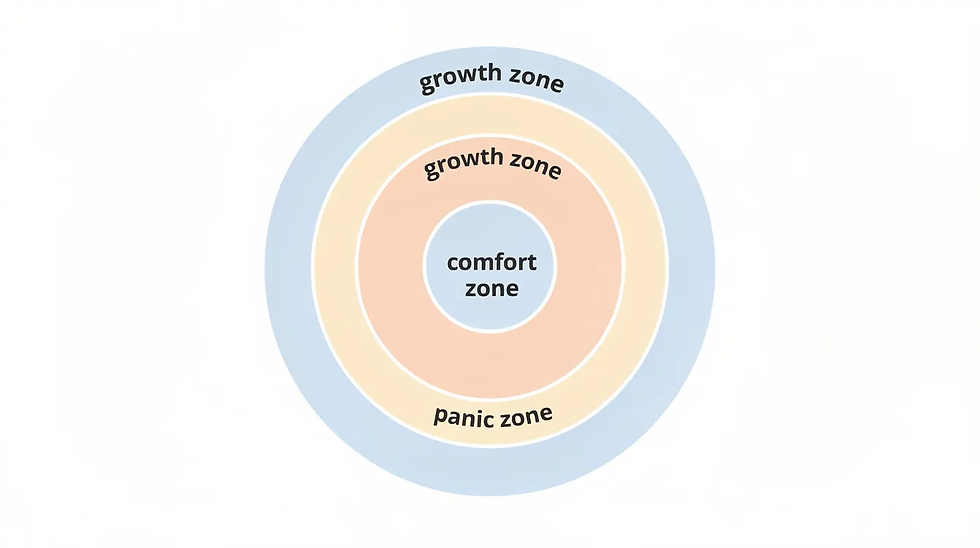
Three zones define your experience:
Comfort zone: Where you feel safe and competent, but no learning occurs
Growth zone: Where you feel challenged but capable—this is where development activities create lasting change
Panic zone: Where challenge overwhelms skill, causing shutdown rather than growth
Growth requires regular, manageable discomfort—not constant overwhelm. Think of it as moving forward one step at a time rather than leaping into chaos.
Concrete comfort-zone expansions:
Speaking up once in your next team meeting
Taking a solo weekend trip to an unfamiliar city
Starting a new hobby class (dance, language, pottery)
Having a difficult conversation you have been avoiding
Attending a networking event alone
Modern lifestyle shifts like becoming a digital nomad represent larger-scale comfort-zone expansion—combining geographic change, cultural immersion, and professional adaptation. But smaller local more experiments work just as well. The principle is identical: normalize the feeling of being a beginner.
Weekly stretch challenge routine: Each week, plan one small action that feels 20-30% outside current comfort—exciting but not terrifying. Track your progress. Over time, what once felt uncomfortable becomes normal, and you naturally reach for new challenges.
Design Daily Development Activities That Actually Stick

Success is built through consistent, small actions taken daily, focusing on the process rather than solely on results. Personal growth happens through your daily routine, not just big breakthroughs. Small, consistent actions often lead to more sustainable transformation than sporadic, major life overhauls.
Six simple development activities to consider:
10 minutes of reading non-fiction or self-growth books
Journaling for 10-15 minutes about thoughts, lessons, and feelings
Walking without headphones—let your mind process and reflect
Mindful breathing or meditation for 5-10 minutes (practicing mindfulness can help cultivate self-awareness and emotional regulation)
Skill practice—deliberate work on a language, instrument, or professional capability
Physical exercise—prioritizing physical health through regular exercise and proper nutrition is essential for personal growth
Continuous learning—through reading, podcasts, or online courses—signals to your subconscious that personal goals are worth the effort.
Habit stacking helps new behaviors stick. Utilizing habit stacking can help link new habits to established routines to encourage positive behavior changes:
Journal immediately after morning coffee
Read during lunch break
Meditate after brushing teeth
Reflect on lessons during evening wind-down
Example workday routine:
Morning (6:30 AM): 10-minute meditation before checking phone
Mid-morning: 15-minute learning input (podcast or article with coffee)
Lunch: 30-minute walk without distractions
Evening: 10-minute journaling about one lesson learned
Example weekend routine:
Morning: 20-minute yoga or meditation
Late morning: 60 minutes reading
Afternoon: Creative pursuit or skill practice
Evening: Weekly reflection on progress and upcoming intentions
Creating a personal development plan involves setting specific, measurable goals that fit into your daily routine, making it easier to monitor progress and achieve objectives. Experiment with a 7-day “growth-friendly routine” and adjust based on energy and your season of life.
Create a Personal Growth Plan You’ll Follow
A well-developed personal development plan helps individuals focus on what’s truly important and consistently work toward their personal development goals. Written plans dramatically outperform vague intentions over the long term.
Five steps to build your plan:
Reflect: What are you satisfied with? What feels stuck or misaligned with values?
Define priorities: Choose 2-3 areas most important given your current life season
Set SMART goals: Specific, measurable, achievable, relevant, time-bound objectives
Choose actions: Identify daily, weekly, and monthly behaviors supporting each goal
Schedule reviews: Plan quarterly check-ins to assess progress and adjust
Setting SMART goals—Specific, Measurable, Achievable, Relevant, and Time-bound—provides a structured approach to personal development by breaking down large objectives into manageable steps.
SMART goal example:
Element | Application |
Specific | Read 12 personal development books |
Measurable | One book per month, tracked in spreadsheet |
Achievable | 45 minutes weekly reading time |
Relevant | Supports value of continuous learning |
Time-bound | Complete by December 31, 2026 |
To create an effective personal development plan, individuals should start with a self-assessment to identify their strengths and then set both short-term and long-term goals. To succeed in personal growth, it is essential to set clear personal development objectives that are realistic and achievable, which helps in monitoring progress and maintaining motivation. |
Break goals into manageable steps:
Daily: Read 10 minutes
Weekly: Complete one 45-minute reading session
Monthly: Finish one book, write brief reflection
Quarterly: Review progress, adjust pace if needed
Use a simple one-page format or digital note—not a complex system. Reducing friction increases follow-through. Creating a personal development plan helps individuals focus on their goals and consistently work towards them, increasing the likelihood of achieving personal growth objectives.
Use Support Systems: Life Coaches, Mentors, and Community
Personal growth accelerates with support, accountability, and outside perspectives. Building positive associations by surrounding oneself with supportive people encourages personal development.
The role of a life coach:
A life coach helps clarify life goals, uncover limiting beliefs, design tailored development activities, and provide guidance through accountability. Coaches ask powerful questions that create insight and maintain momentum through regular check-ins. They are particularly valuable during transition points—career changes, relocation, or major decisions.
Coach vs. mentor:
Life Coach | Mentor |
Formally trained in coaching methodologies | More experienced in specific domain |
Addresses holistic life goals | Shares knowledge from personal journey |
Structured sessions with defined relationship | Often informal and organic |
Best for overall life direction | Best for career or skill-specific guidance |
Low-cost or free alternatives: |
Peer accountability groups with friends or colleagues
Online communities (Reddit, Discord, industry forums)
Local meetups focused on specific growth areas
Library books, podcasts, and free online courses
Questions to ask prospective coaches or mentors:
What is your background and approach to coaching/mentorship?
How do you measure success, and how will we track my progress?
What are your fees, session frequency, and contract terms?
Can you share examples of clients in situations similar to mine?
Personal Growth Examples for Different Life Paths
Growth looks different depending on season of life, responsibilities, and aspirations. No path is more valid than another—the key is alignment between your personal growth journey, core values, and realistic life constraints.
Example 1: Mid-career professional pursuing advanced education
A 35-year-old project manager feeling intellectually understimulated enrolls in an online master’s program starting fall 2025, targeting completion by 2027. Many people embark on professional development by creating plans that specify their professional goals and the tangible steps that they can take to achieve them. This addresses intellectual development, credential-building, and network expansion. Daily growth activities include attending classes, dedicating 10-15 hours weekly to coursework, and journaling about applications to current work.
Example 2: Digital nomad lifestyle (2024-2026)
A 28-year-old technology professional with core values of freedom, adventure, and autonomy becomes a digital nomad. This lifestyle supports growth through independence, cultural exposure, and resilience-building. Challenges include isolation, time-zone friction, and maintaining routines across locations. Success requires strict growth habits despite changing environments, actively building community through coworking spaces, and regular check-ins with mentors.
Example 3: Parent using micro-habits and boundaries
A 42-year-old caregiver managing children and aging parent feels depleted. Rather than adding more to a full plate, they focus on quality over quantity:
Five-minute morning meditation before household chaos
15-minute audiobook during commute
Weekly 30-minute walk alone
Monthly lunch with a friend
Setting boundaries—saying no, delegating, asking for help—becomes a growth activity when rooted in values rather than guilt. The message is not “do more” but “align time with values and protect that alignment.”
Long-Term Perspective: Growing Over Years, Not Days
Consistent small improvements are more effective for long-term success than striving for overnight transformation. Meaningful change unfolds over years and decades, not overnight. This reality is liberating: if transformation is measured in years, then daily actions become extraordinarily powerful.
Create a gentle 3-5 year vision:
Rather than rigid timelines, describe the kind of human being you want to become:
“By 2029, I want to be someone who is confident in my expertise, maintains work-life boundaries, exercises regularly, has strong friendships, and feels proud of my contributions.”
This vision-based approach allows flexibility, focuses on identity rather than external outcomes, and creates space for new opportunities along the way.
Annual reviews as touchstones:
Each December or birthday, reflect:
What changed this year? What remained stuck?
Where did I grow? Where did I resist growth?
Did daily actions reflect stated values?
What adjustments will I make for the coming year?
Celebrating small wins helps maintain motivation throughout the personal growth journey.
Handling setbacks:
Illness, job loss, breakups, and family crises are normal parts of a growth journey—not evidence of failure. The distinction: resilience is not determined by avoiding setbacks but by how quickly you restart and what you learn from the interruption.
Treat personal growth as a lifelong practice, similar to fitness or learning a language, with seasons of intensity and rest. Some years demand intensive focus due to major transitions; other years call for consolidation. Both are valuable and necessary for overall well being.
Frequently Asked Questions About Growing Personally
How much time do I need to grow personally each day?
Even 15-20 intentional minutes daily—reading, journaling, reflection, or practice—can create significant change over a year. Consistency matters more than intensity. Start with 10 minutes in the morning and 10 in the evening. Once established, increase time if it feels sustainable. A stepping stone approach works better than dramatic commitments you cannot maintain.
Do I need a life coach to grow personally?
A life coach can accelerate growth and provide structure and accountability but is not mandatory. Many individuals achieve substantial self development through books, free online courses, mentors, and peer accountability groups. A coach is most helpful during transition points—career change, relocation, or when feeling stuck. If budget is a concern, start with free resources and consider coaching when facing specific challenges where outside perspective would provide guidance.
What if I keep starting and stopping my personal growth habits?
This pattern is common and not a sign of personal weakness. Shrink your goals—if 30-minute exercise is not sticking, commit to 10 minutes. Remove friction by preparing the night before (lay out journal, queue audiobook). Tie habits to existing routines through habit stacking. Most importantly, focus on restarting quickly after lapses rather than waiting for a “perfect Monday.” The only problem is extended pauses, not occasional misses.
How can I grow personally if I have very little money?
Many powerful growth tools cost nothing: library books, podcasts, free online courses, walking, journaling, and time in nature. Public resources like community centers often offer workshops. Online communities provide support and different perspectives. Self awareness and consistent habits, not expensive programs, drive most long-term growth. Invest time and attention when money is limited—gain confidence through practice, not purchases.
How do I balance personal growth with rest and enjoyment?
Growth includes learning to rest, play, and set boundaries—overwork is not a sign of personal development. Schedule both growth activities and restorative time (hobbies, nature, social connection) each week. Judge progress by life satisfaction and values alignment, not by how busy you are. A fulfilling life requires both intentional development and genuine enjoyment. The end goal is not productivity for its own sake but becoming a better person who also experiences joy.
Conclusion: Commit to Becoming the Best Version of Yourself
Personal growth is fundamentally a commitment to becoming increasingly self-aware, capable, resilient, and aligned with your core values through daily, intentional choices. It is not reserved for those with perfect circumstances, advanced degrees, or abundant resources. The world opens to most people who simply decide to begin.
You do not need to overhaul your entire daily life today. Start with one small step: choose a single habit you will practice for the next 30 days, one stretch action you will take this week, and one written goal you will commit to within the next 24 hours.
The person you become in five years will be shaped by the ordinary choices you make this month. Mark Twain noted that the swiftest way to achieve something is simply to begin. Personal growth is not about perfection it is about progress, self compassion, and the quiet determination to keep moving forward even when the path is unclear. Your best version is not a destination you reach but a direction you travel. Start now. Create your future one intentional day at a time.


