

Analytical Understanding: How To Build Strong Analytical Thinking Skills in 2026

Analytical understanding is the deep, structured grasp of a problem, system, or dataset that lets you explain “what is happening, why, and what to do next.” It’s the bridge between raw data and effective decisions.
Consider a 2026 product manager noticing a sudden 15% drop in customer retention. Instead of guessing, she segments users by acquisition channel, reviews onboarding completion rates, and conducts customer interviews. Within two weeks, she identifies that a recent checkout redesign confused mobile users—and proposes a targeted fix.
That’s analytical understanding in action: combining data analysis with critical evaluation and creative problem solving to reach a logical conclusion.
In a data-driven world of AI dashboards and real-time metrics, these thinking skills now matter for everyone—not just technical staff. This article covers definitions, core skills, step-by-step processes, career applications, practice ideas, and FAQs, all in practical, non-academic language.
What Is Analytical Understanding? (And How It Relates to Analytical Thinking)
Analytical understanding is the outcome of analytical thinking: the ability to see structure, causality, and options within complex problems. While analytical thinking is the active process—breaking down, comparing, quantifying—analytical understanding is the end state: a coherent mental model you can explain to others and act upon.
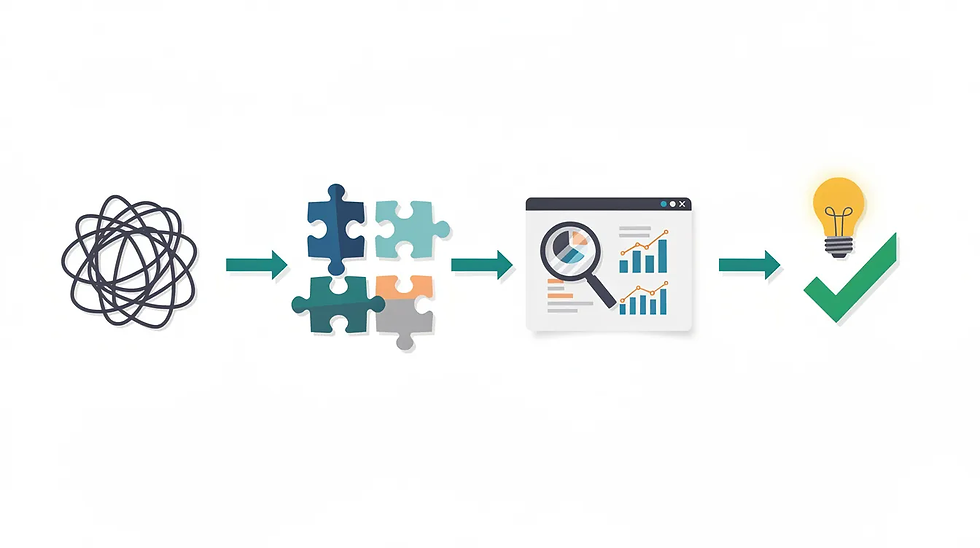
Analytical thinking involves using a systematic approach to make decisions or solve problems by breaking down information into parts to better understand it and reach sensible conclusions. The understanding that emerges allows you to transfer knowledge to new situations, not just repeat memorized answers.
Core features of analytical understanding include:
Working with complex information across multiple sources
Connecting data points to reveal patterns and relationships
Checking assumptions against evidence
Forming data-driven explanations that guide action
This relates closely to analytical reasoning (logic, patterns, cause/effect) and data literacy (reading charts, understanding metrics, evaluating data quality). Importantly, analytical understanding applies beyond numbers—to policies, legal arguments, medical cases, customer journeys, and project management plans.
Analytical Thinking vs Critical and Creative Thinking
Strong problem solvers don’t rely on one thinking style. They cycle between analytical, critical, and creative thinking, using each mode deliberately based on what the situation demands.
Here’s how they differ:
Analytical thinking involves breaking down complex problems into smaller parts to understand them better. It focuses on data analysis and logical reasoning—quantifying, comparing, and identifying patterns.
Critical thinking requires examining information, reflective thinking, and using appropriate skills to come to a conclusion. While analytical thinking is primarily concerned with understanding and solving problems through data and logic, critical thinking incorporates a broader evaluation of evidence and alternative viewpoints. Critical thinkers question sources, spot bias, and test arguments.
Creative thinking generates novel explanations and solutions once analysis reveals constraints. It’s about imagining new possibilities within the bounds your analysis has defined.
Challenging assumptions involves seeking opposing viewpoints and testing hypotheses to determine if beliefs are based on data or bias. This is where critical and creative thinking intersect with analytical work.
Example: A 2026 operations manager facing shipping delays first analyzes logistics data (analytical), then questions whether vendor reliability claims hold up under scrutiny (critical), and finally devises an AI-optimized routing policy that cuts delays by 25% (creative).
Analytical understanding improves when these three modes are consciously combined and sequenced.
Core Analytical Skills That Build Analytical Understanding

Here’s a high-level overview of key analytical skills that underpin analytical understanding in real workplaces. You don’t need to be in data science to use them—they’re relevant from HR and product management to healthcare and public policy.
Skill | What It Means |
Data analysis & data literacy | Reading dashboards, grasping basic statistics, spotting misleading charts with truncated axes |
Problem decomposition | Splitting complex problems into smaller, answerable questions to reduce cognitive load |
Pattern recognition | Spotting trends and correlations while avoiding “correlation equals causation” errors |
Logical and analytical reasoning | If-then thinking, scenario modeling, consistency checks across data points |
Evaluation & judgment | Weighing trade-offs, risk versus reward, opportunity cost quantified where possible |
Communication of insights | Turning complex analysis into clear, actionable recommendations others can understand |
Creative synthesis | Designing multiple solutions from the analyzed information |
Reflection & feedback | Reviewing outcomes to refine future analysis through the learning process |
Visualizing relationships can be enhanced through mind maps, flowcharts, or systems diagrams to understand how different parts of a problem relate to one another. These visual tools support several skills above. |
How Analytical Understanding Works: A Simple Step-by-Step Process
Analytical understanding isn’t a mysterious talent. It can be approached as a repeatable process that you develop through deliberate practice.
Here’s a 7-step framework:
Clarify the question. Limit it to one measurable outcome (e.g., “increase trial conversion in Q3 2026 by 15%”).
Gather relevant data. Collect structured and unstructured information, ensuring recency and adequate sample size.
Break into parts. Use fishbone diagrams or similar tools to identify root causes and sub-questions.
Analyze. Apply statistical tests where appropriate—look for significance, not just correlation.
Generate options. Develop hypothesis-driven alternatives and test hypotheses through A/B tests or scenario modeling.
Decide and act. Prioritize by ROI and implement the strongest option.
Review. Track KPIs for 30-90 days post-implementation.
Three types of reasoning support this process:
Deductive reasoning starts with a general statement or hypothesis and examines possibilities to reach a specific, logical conclusion, often used in scientific methods to test hypotheses.
Inductive reasoning involves compiling information and data to establish a general assumption based on specific observations, often leading to conclusions that may not be universally true.
Abductive reasoning begins with incomplete evidence and leads to the most likely explanation for a given problem, often used in fields like medicine to diagnose illnesses based on symptoms.
Example: A 2026 e-commerce team notices average order value dropped in May. They clarify the question (May vs prior months), gather information from sales logs, decompose by segment (new vs repeat, mobile vs desktop), analyze (find 25% mobile cart abandonment from checkout friction), generate options (simplify UI, test promos), decide (A/B test yields 18% uplift), and review (sustains +12% AOV over 60 days).
Real-World Examples of Analytical Understanding at Work
Analytical understanding is most visible in how professionals handle complex, ambiguous situations. Here are workplace scenarios across various industries:
Marketing: A 2026 product launch underperforms in Region A (10% conversion vs 25% elsewhere). The team segments metrics in Google Analytics, questions assumptions about local ad effectiveness, and tests hypotheses about cultural fit. Insight: messaging didn’t resonate locally. Pivot to geo-targeted creatives yields 22% uplift.
Finance: Q1 2025 shows budget overruns. A financial analyst uses variance analysis (actual vs budget) and forecasting models to identify spending patterns. Adjustments to 2026 projections save $500K through better financial management and strategic planning.
Operations: A logistics team applies Pareto analysis (80/20 rule) and finds that 3 vendors cause 80% of delays. Data-driven fixes—without cost increases—cut delivery times by 28%.
Healthcare: Epidemiological analysis using cohort studies helps prioritize vaccine distribution, reducing cases by 40% in target populations.
In each case, the professional moved from raw data to analytical understanding by segmenting data, questioning assumptions, and communicating insight through evidence-based storytelling.
Are You an Analytical Thinker? Quick Self-Check
This informal self-check helps you recognize existing strengths. It’s not a scientific test—just a prompt for reflection.
Answer yes or no:
I naturally look for the cause behind trends, not just the trend itself.
I enjoy working with spreadsheets, dashboards, or data visualization tools.
I often build simple pros/cons lists or models before making decisions.
I question data sources and ask about sample sizes before trusting conclusions.
I find it satisfying to explain complex ideas in simple terms.
I regularly revisit past decisions to see what worked and what didn’t.
I notice when arguments rely on emotion rather than evidence.
Interpreting results:
Several “yes” answers suggest you already have an analytical mindset. Focus on sharpening communication and creative thinking to balance your profile.
Several “no” answers highlight growth opportunities. Start by deliberately practicing breaking complex information into simpler pieces—one question at a time.
How Analytical Understanding Helps You Solve Complex Problems
Complex problems usually have multiple causes, stakeholders, and constraints. They require more than intuition—they demand structured analysis.
Analytical understanding supports:
Prioritization: Identifying high-impact levers instead of tackling symptoms
Scenario planning: Considering alternative futures using data and assumptions
Risk management: Quantifying downside and upside rather than guessing
Iterative improvement: Using data from experiments to refine solutions over time
Having excellent analytical skills can prevent potential mistakes that might have arisen without situational analysis, helping individuals spot great opportunities and capitalize on them when they arise.
Mini-case: A product team tracked subscription retention across 2024-2026 using cohort analysis and A/B tests. Each quarter, they refined onboarding based on data, achieving a 35% improvement in 90-day retention. This iterative approach—possible solutions tested, measured, and refined—demonstrates how research skills and analytical reasoning compound into better outcomes.
Analytical understanding is especially valuable when information is incomplete or conflicting, because it imposes structure and clarity on ambiguity.
Careers That Rely Heavily on Analytical Understanding
If you’re considering data-driven or analysis-heavy roles in the 2024-2030 job market, here’s where analytical skills are central:
Role | Focus | Typical Tools |
Data Analyst / BI Analyst | Turning company data into insights and dashboards | SQL, Excel, Tableau |
Data Scientist / ML Specialist | Building models, interpreting outputs, guiding business strategy | Python, R, machine learning frameworks |
Business/Product Analyst | Connecting customer behavior, product metrics, and outcomes | Mixpanel, Amplitude, SQL |
Financial Analyst | Forecasting, valuation, risk assessment | Excel, DCF models |
Cybersecurity Analyst | Detecting anomalies, investigating incidents | SIEM tools, log analysis |
Policy/Healthcare Analyst | Evaluating programs using quantitative and qualitative data | R, statistical software |
Analytical skills are essential in various fields such as marketing, research, project management, data science, accounting, and finance, enabling individuals to analyze situations, draw conclusions, and make better-informed decisions. |

In the workplace, analytical thinking is essential for making sound judgments and solving problems, playing a crucial role in many professions. Analytical thinking enables individuals to analyze situations and people, draw relevant conclusions, and make better-informed decisions, leading to better outcomes and more rational decision making.
Even general management, HR, and marketing roles now expect data-driven, analytical reasoning. LinkedIn postings increasingly list “data-driven” as a requirement—this isn’t limited to information technology anymore.
Practical Ways To Improve Your Analytical Thinking Skills
Analytical understanding is learnable. It improves with deliberate practice, not just higher education.
To improve analytical thinking skills, individuals can conduct thorough research, gather information, consider multiple solutions, analyze their solutions, and evaluate the success of their chosen solution.
Here are actionable strategies:
Work with real data: Download open datasets from data.gov or Kaggle, or use your company’s reports to answer specific questions through your own research process.
Practice structured note-taking: Outline arguments, processes, or meetings into components and connections.
Use “why?” chains: For any issue, ask “why” 3-5 times to get to root causes (the Toyota “5 Whys” method uncovers 80% of roots).
Build simple models: Create basic spreadsheets to test scenarios—revenue projections, staffing needs, project timelines.
Reflect after decisions: Review outcomes monthly and note which assumptions held or failed.
Learn foundational statistics: Averages, distributions, correlations, confidence intervals—and why they matter.
Engage in debates: Practice defending and challenging positions with evidence, strengthening your argumentation skills.
Mental models such as First Principles Thinking help deconstruct complex problems into their fundamental truths for deeper analysis. The Feynman Technique involves breaking down a complex topic by explaining it in simple, plain language to highlight gaps in understanding—try explaining your analysis to someone unfamiliar with the topic. Start small—20-30 minutes per week—to build consistent habits rather than short, intense bursts. On the job experience combined with deliberate practice accelerates development of new skills.
Using Data Analysis Without Becoming a Data Scientist
Analytical understanding in 2026 doesn’t require advanced coding. It requires comfort with data-driven thinking and basic data literacy.
Here are baseline practices:
Learn to read common chart types (line, bar, scatter, histograms) and spot misleading axes or scales—3D charts can inflate perceived trends by 30% or more.
Always ask about data source, time period (Q1 2026 vs 2021-2025 average?), and sample size before trusting a chart.
Get comfortable with one analysis tool (Excel, Google Sheets, or a BI dashboard) for filtering, pivoting, and simple visualizations.
Distinguish between correlation and causation using concrete examples: ice cream sales correlate with drownings due to seasonality, not causation.
Use data to challenge and refine—not replace—domain expertise and on-the-ground observations.
Data mining and systems analysis sound technical, but even probing questions about where numbers come from builds analytical capability. These are now baseline skills for managers, not just technical support staff.
Common Pitfalls That Block Analytical Understanding
Many smart professionals still reach poor conclusions because of common thinking traps. Recognizing them helps you find solutions that actually work.
Pitfall | What Happens |
Confirmation bias | Looking only for evidence that supports your first hunch |
Overfitting stories to sparse data | Building strong narratives from weak evidence (one month’s results) |
Ignoring base rates | Not comparing current data with historical norms or industry benchmarks |
Mistaking activity for insight | Collecting dashboards without answering a specific question |
Analysis paralysis | Never deciding because you keep seeking more data |
Oversimplification | Forcing complex problems into a single metric or cause |
Safeguard: For any conclusion, identify at least one alternative explanation and one potentially disconfirming data point. This habit alone protects against several pitfalls. |
Strong critical thinking skills in everyday life help you catch these errors before they derail your analysis.
How To Communicate Analytical Insights So Others Understand
Analytical understanding only creates value when others can grasp and act on your insights. Communication is itself an important skill—you must identify what matters most and why.
Practices that work:
Start with the main message first (“executive summary”) before diving into details.
Use clear visuals (simple charts, tables) and label them with plain-language titles—not technical jargon.
Translate statistics into business impact: “2% churn reduction equals 500 extra customers per year” lands better than “p < 0.05.”
Distinguish facts, interpretations, and recommendations explicitly.
Tailor depth to the audience: high-level for executives, more granular for technical peers.
Invite questions and be transparent about uncertainties and assumptions—this builds trust.
Your ability to synthesize information into a coherent story separates valuable information from noise. This is where deeper understanding meets practical impact in your professional and personal life.
Daily Micro-Habits To Become More Data-Driven
These 5-10 minute habits gradually raise analytical understanding without requiring big time blocks:
Morning metric review: Check one key metric daily and write one sentence about what changed and why it might matter.
Evidence check: When reading news, identify the claim, evidence, and any missing data before sharing.
Lessons learned: Turn at least one meeting per week into a short review with concrete data or examples.
Decision log: Note major decisions, reasons, and expected outcomes for later review—track your accuracy over 6 months.
Estimation practice: Estimate sizes, times, or costs, then check against reality to calibrate intuition (Fermi problems build this skill).
Crossword puzzles or strategic board games: These develop pattern recognition and logical solution finding in low-stakes environments.
Consistency over months—mid-2024 to mid-2025, for example—compounds into noticeably stronger analytical thinking skills. Even generative AI tools work better when you bring sharp analytical questions to them.
FAQs About Analytical Understanding, Analytical Thinking, and Data Literacy
What is the difference between analytical understanding and simple information recall?
Recall is remembering facts—numbers, definitions, procedures. Analytical understanding means explaining why those facts matter, how they connect, and what would change if conditions change.
Example: Knowing your monthly churn rate is 3% is recall. Understanding which customer segments drive it, how pricing affects it, and what interventions would reduce it—that’s conceptual understanding. Analytical understanding allows you to transfer new knowledge to similar but novel situations.
Can I develop strong analytical skills if I don’t like math?
Yes. Analytical thinking is broader than mathematics. It includes structuring problems, evaluating arguments, and using qualitative evidence from multiple angles. Focus on everyday tools: spreadsheets, simple percentages, visual dashboards. Many people develop comfort with numbers by analyzing hobbies—sports stats, personal budgeting, even travel planning. The intended use matters more than complex formulas. Gradual exposure through practical projects builds confidence.
How long does it take to noticeably improve analytical thinking skills?
With consistent weekly practice (1-2 hours spread across a week), most people notice changes in clarity and decision making within 8-12 weeks. Deeper, career-level changes—like leading data-driven projects confidently—typically develop over 6-18 months of deliberate practice. Track your progress by reviewing old analyses or reports every few months to see improvement. This research approach to your own development accelerates growth.
What are some good starting resources to strengthen analytical reasoning?
A mix of formats works best:
Books: Thinking, Fast and Slow (Kahneman), Naked Statistics (Wheelan)
Courses: Google Data Analytics Certificate, DataCamp Excel courses
Practice: Analyze freely available datasets (government open data, public company financials)
Discussion groups or peer review of analyses at work can accelerate learning via feedback. Other skills like writing and presenting benefit from similar practice-and-feedback loops.
How can managers help their teams become more analytical and data-driven?
Define a small set of 3-5 key metrics per team and review them regularly with clear questions: “What surprised us this month?”
Create a culture where hypotheses and experiments are welcomed—people should feel safe admitting uncertainty or errors in analysis. Offer light training, pair less-experienced staff with analytical mentors, and recognize clear, evidence-based thinking in performance reviews. This work environment supports sustained improvement across two groups: those with natural analytical inclinations and those still developing such skills.
Conclusion: Building Analytical Understanding for a Data-Driven Future
Analytical understanding isn’t a talent you’re born with—it’s a capability you build through deliberate practice over time. It combines analytical thinking (breaking down problems), critical thinking (evaluating evidence), and creative thinking (generating creative solutions) into a coherent approach that turns complex problems and data into confident, informed decisions.
The human factors in analysis—framing questions, judging evidence, and making wise choices—will only become more valuable as AI tools and data volumes grow through 2026 and beyond. Machines can process; humans must understand.
Pick one or two practices from this article to start this week. Keep a decision log. Ask “why” five times. Review one metric each morning. These small actions compound into the analytical mindset that defines career impact.
Your ability to demonstrate analytical thinking—to solve problems, gather information, and draw conclusions from data—is now essential across every industry. Start building today.


