

Test Taking Strategies: Practical Tips to Ace Your Next Test

From weekly quizzes in high school to major standardized tests like the SAT, ACT, and AP Exams, tests shape grades, graduation paths, and scholarship opportunities for millions of students. In 2026, these assessments remain pivotal—with over 1.9 million students taking college entrance exams annually and state assessments correlating strongly with graduation rates.
Here’s the good news: effective test-taking involves preparation, anxiety management, and strategic answering—all learnable skills, not inherited talents. Even students with strong knowledge can lose points without a clear plan for the entire test.
This guide covers test prep habits, practice test use, managing test anxiety, and flexible strategies for multiple choice, essay questions, and problem-solving. These practical, classroom-tested test taking tips will help you prepare smarter and perform better on exam day.
Section 1: Strong Test Prep Habits Weeks Before Exam Day
Effective test taking starts long before the big exam. Developing good study habits long before test day is crucial for understanding and retaining information, which includes doing homework assignments carefully, reviewing notes daily, and creating study guides.
Build a 2-4 week test prep plan that spreads study sessions across days:
Schedule specific blocks: Study algebra for 30 minutes Monday-Thursday at 7:00 pm
Review class materials daily: Go through notes, homework, and previous tests to think like your teacher and predict likely test questions
Use active learning: Active recall improves learning by testing oneself with flash cards or teaching concepts to others instead of passively re-reading notes
Create subject-specific tools: Build formula sheets for math, concept maps for history, or vocabulary lists for language arts
Studying a little each day leading up to a test helps identify tough concepts or weak areas in your knowledge, making it easier to prepare effectively and focus your hard work where it matters most.
Section 2: Using Practice Tests and Study Aids Effectively
Practice tests are one of the most powerful test taking strategies for improving test scores. Research shows they outperform passive rereading with significant effect sizes for retention and recall. Simulating test conditions helps prepare for the test format. Here’s how to maximize practice questions:
Find realistic materials: Use released exams from teachers, Khan Academy’s free SAT practices, or class review sessions
Simulate the real exam: Work through the entire test in timed sessions, in a quiet room, with no phone—treating it like the actual exam day
Review results systematically: Mark missed questions, identify patterns (rushing? careless errors? content gaps?), and turn mistakes into targeted study lists
Pair with spaced repetition: Use flash cards and topic checklists throughout the week, reviewing material at increasing intervals
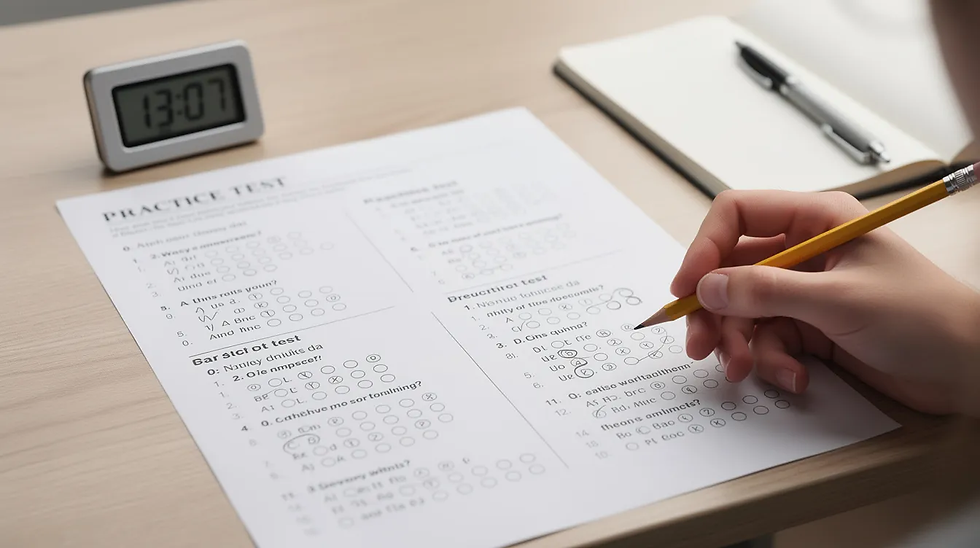
Aim for 3-6 full-length practice tests before any big test, spaced across several weeks rather than crammed into one weekend.
Section 3: Reducing Test Anxiety Before and During the Exam
Nearly every student experiences some level of test anxiety, which can range from mild nervousness to debilitating stress. Even well-prepared students can feel shaky when facing high-stakes standardized tests. Managing anxiety through breathing exercises, visualization, and positive self-talk can enhance test performance:
Try 4-7-8 breathing: Inhale for 4 counts, hold for 7, exhale for 8—this activates your body’s relaxation response
Practice brief meditation: Practicing meditation or taking a short stretch break before or during a test can help reduce anxiety and improve focus
Reframe negative thoughts: Replacing negative thoughts with positive affirmations (“I’ve prepared for this, I know this material”) can be an effective strategy for managing test anxiety
Prepare logistics early: Pack materials the night before, know your test location, and plan to arrive 10-15 minutes early
Arriving early at a test location can help decrease stress and allows students to organize their materials and settle into a positive mindset before the test begins. If anxiety feels overwhelming, talk to school counselors or teachers for extra support.
Section 4: Night-Before and Morning-Of Exam Day Checklist
Small choices the night before and morning of can boost your brain and focus more than any last minute cramming. In fact, cramming for a test is counterproductive as it increases stress and negatively impacts sleep, making it less likely for students to retain information compared to consistent study habits.

Night before routine:
Light review of key formulas or concepts only
Lay out clothes, pack ID, calculator, pencils
Set your alarm with buffer time
Aim for a full good night’s sleep—8-9 hours for teens
Morning of routine:
Eating a healthy breakfast on test day is important as it helps maintain energy levels and focus, with a mix of complex carbohydrates and protein being ideal (oatmeal with nuts, eggs and whole-grain toast)
Stay hydrated with water, avoiding heavy sugar or energy drinks
Use a calming pre-test ritual: a short walk, deep breaths, or music
Section 5: Smart Strategies During the Test
Once the test begins, success depends on managing time, questions, and attention. Poor time management can cause panic and errors during tests.
Start with these techniques:
Listen carefully: Listening to the instructions provided by the teacher or proctor before starting the test is crucial, as it may include important details about test structure, time limits, and grading techniques
Scan the entire test first: Note the number of questions, point values, and time-intensive sections to create a time budget
Do a brain dump: Doing a “brain dump” by writing down key facts, data, or formulas on scrap paper before starting can help relieve stress and allow you to focus on the questions without worrying about recalling information
Answer easier questions first: Build momentum and confidence before tackling harder ones
Leave time to review: After completing the test, double-check your work to ensure you didn’t miss any questions and to correct obvious mistakes
Creating a time budget allows for better management of exam time based on question difficulty. Failing to read instructions thoroughly can lead to lost points—so stay calm and read carefully.
Section 6: Multiple Choice, Essays, and Problem-Solving Questions
Multiple choice strategies:
Read stems carefully before looking at answers
Eliminate obviously wrong answers first (this can double your odds of selecting correctly)
Watch for absolutes like “always” or “never”—these are often incorrect
Not reading all answer choices increases the likelihood of selecting an incorrect answer
Only change an answer if there is certainty that the first answer was wrong to avoid mistakes
Essay test strategies:
Underline the prompt and identify key verbs (“discuss,” “compare,” “analyze”)
Create a brief outline before you write
Use clear topic sentences and fill your space
Leave a minute to reread for clarity and grammar
Math and problem-solving:
Show all work and label units
Check answers with estimation
Watch for common errors like sign mistakes
Common test-taking mistakes include rushing, misreading directions, poor time management, and changing correct answers to wrong ones.
Section 7: Learning from Each Test to Improve the Next One
Every exam—whether a quiz or a major standardized test—provides feedback that can raise test scores on the next test.
Review graded tests quickly: Analyze results within 48 hours while material is fresh
Note patterns: Are you always rushing the last page? Missing vocabulary? Losing points on showing work?
Turn errors into study lists: Create personalized review material from missed questions
Ask for help: When possible, talk to your teacher for clarification on weak areas
This reflection process transforms even a disappointing grade into a roadmap for higher academic success on future exams. Track your patterns over a semester to see real improvement in your confidence and skills.
Conclusion: Building Test Confidence That Lasts
Effective test taking combines preparation, practice tests, anxiety management, and smart in-test strategies. When you develop good study habits weeks before exam day, simulate real exam conditions with practice questions, and use techniques like brain dumps and time budgeting during the test, you set yourself up for stronger performance.
These test taking strategies benefit you far beyond a single exam day. The skills you build now—active recall, stress management, strategic answering—will help with college entrance tests, certification exams, and lifelong learning situations. You don’t need to change everything at once. Pick one or two strategies from this guide and apply them to your very next test.
With consistent practice and reflection, you can steadily reduce test anxiety and build real confidence over the course of a semester or school year. Your next big exam is an opportunity to put these techniques into action—and every test after that becomes easier when you learn from the one before.
FAQs About Test-Taking Strategies
How far in advance should I start test prep for a big exam?
Start at least 2-3 weeks before a major unit test and 6-8 weeks before big standardized tests. Break prep into short daily sessions (20-30 minutes) rather than long weekend marathons. This approach reduces test anxiety and improves retention through spaced repetition.
What can I do during a test if I suddenly freeze or blank out?
Pause and take 3-5 deep breaths. Sip water if allowed. Start with a very easy question to rebuild momentum. Quickly jot down anything you remember about the topic on scratch paper—this often unlocks memory and lowers stress.
How many practice tests should I take before a standardized test?
Aim for 3-6 full-length practice tests spaced across several weeks. Quality review after each test—analyzing errors and adjusting your study focus—matters more than simply completing as many tests as possible.
Is it better to guess or leave answers blank on multiple choice tests?
On most modern classroom tests and standardized tests without a guessing penalty, make an informed guess rather than leaving questions blank. Always use elimination strategies first. Check your specific exam’s rules before test day.
How can parents help teens who struggle with test anxiety?
Parents can support consistent study routines, provide a quiet study space, and help schedule regular practice test sessions. Encourage healthy sleep and nutrition before exam day, and seek input from teachers or counselors if anxiety is severe or persistent.


