

Good Study Habits: How to Build a Study Routine That Actually Works

It’s 2026, and many students still approach exams the same way: marathon rereading sessions, last-minute cramming, and hoping something sticks. Yet research from the past two decades consistently shows these passive strategies produce weak results. Watching lectures on 2x speed or highlighting entire textbook pages creates an illusion of learning without the substance.
Good study habits aren’t about studying more—they’re about studying smarter. Effective studying focuses on the quality of the session, not just its duration. The habits you build around where, when, and how you study determine whether your effort translates into real knowledge and better academic performance.
This article walks you through evidence-backed strategies: active recall, practice tests, spaced repetition, time management, and techniques to eliminate distractions and stay focused. Whether you’re in high school, college, or returning to school as an adult learner, these approaches will help you build a study routine you can actually sustain.
Understanding Good Study Habits vs. Bad Ones
The difference between effective study habits and ineffective ones comes down to engagement. Passive habits—rereading class notes, highlighting text, watching lectures without pausing—feel productive but rarely produce lasting memory. Active habits—summarizing in your own words, self-quizzing, working through practice exam questions—force your brain to retrieve and process information, which strengthens learning.
Key characteristics of good study habits:
Clear goals for each study session (not just “study biology”)
Active engagement with the same material through multiple methods
A regular, predictable study schedule
Minimal multitasking and protected focus time
Attention to sleep and well being
A bad habit pattern in action: It’s the night before your May 2026 biology final. You’re on your bed, textbook open, scrolling TikTok between paragraphs, music playing, phone buzzing with group chat notifications. After four hours, you’ve “covered” everything but can’t recall the major concepts.
A good habit pattern instead: Starting six days before the exam, you review one chapter per day using flashcards you created. You quiz yourself without notes, check answers, then explain the trickiest concepts out loud in your own words. Your phone stays in another room. By exam day, the material feels familiar because you’ve actually retrieved it from memory multiple times.
The study cycle involves previewing material, attending class, reviewing notes within 24 hours, and conducting weekly reviews. This cycle—not a single cramming session—builds durable knowledge. The rest of this article shows you exactly how to shift from passive to active, from random studying to a structured study plan.
Core Study Strategies That Actually Work
This section covers the most researched, effective study strategies you can start using this week. Active study strategies, such as self-quizzing and summarization, are more effective for learning than passive strategies like rereading notes. A 2021 study found that students using active methods scored 11.1% to 16.6% higher on exams than those who didn’t—even when total study hours were equal.
The main strategies include:
Practice tests and active recall
Explaining concepts in your own words
Spaced repetition instead of cramming
Structured study groups
Each approach applies differently depending on your course type—whether you’re preparing for psychology multiple-choice exams, calculus problem sets, or history essay midterms.
Use Practice Tests and Active Recall

Practice tests and self-quizzing rank among the most powerful study strategies because they force you to retrieve information from memory rather than passively recognize it. Active learning techniques, such as self-quizzing and practice tests, significantly improve retention by requiring students to retrieve information from memory. This retrieval process strengthens neural pathways far more than simply rereading the same material.
Concrete examples:
Turn lecture slides into question cards and quiz yourself without looking at notes
Download old exams from your course site and complete them under timed conditions
Write a 20-question mock test two days before your June 2026 midterm
The key is checking your notes only after attempting each answer. This “test-then-check” approach helps you identify gaps and correct errors, which deepens learning. Even short quizzes—5-10 questions done three or four times a week—beat long, unfocused rereading sessions. Students in the 2021 PMC study who completed problem sets under exam-like conditions saw 7.7% score improvements.
Explain Concepts in Your Own Words
Restating ideas in your own words deepens understanding because it requires you to process information, not just copy it. Using generative strategies like summarization and self-explanation can enhance long-term retention of information compared to passive strategies like rereading. When you translate a formal definition into casual language, you’re building semantic networks that connect new knowledge to what you already know.
Specific techniques:
Write a 3-sentence summary after each chapter
Record a 2-minute voice note explaining a theory as if to a friend
Rewrite definitions without looking at the textbook
Worked example: Your psychology textbook defines “operant conditioning” formally. Instead of memorizing the definition, explain it casually: “It’s like training a dog—when the dog sits and gets a treat, it learns to sit more often. The treat reinforces the behavior. That’s different from just watching someone else train a dog.”
This habit translates directly to better performance on short-answer and essay exam questions, where you must generate explanations rather than recognize correct answers. For a practice exam, try answering questions using only your own words before comparing to the official definitions.
Apply Spaced Repetition Instead of Cramming
Spaced repetition means reviewing material multiple sessions over days and weeks instead of cramming it all into one session. Using spaced repetition, which involves reviewing information at increasing intervals, can significantly improve retention and understanding of study material.
A concrete spacing example:
Review Week 1 material again in Week 2
Review it once more in Week 4
Final review the week before your December 2026 exam
Research shows that 12 hours of study spaced over 4 weeks produces better results than 12 hours crammed into two days. The American Psychological Association’s review of decades of data found that equal total study time yields 20-50% better retention when distributed across multiple sessions rather than massed together.
Tools and approaches:
Paper flashcards with dates written on the back
Digital apps that algorithmically schedule reviews based on forgetting curves
A simple calendar reminder to revisit older material each week
Distributing studying this way supports both memory and well being by lowering last-minute stress before big exams. Instead of panicking the night before your SAT or university finals, you’ll have reviewed the key points multiple times and can approach exam day with confidence.
Use Study Groups the Right Way
Study groups can boost motivation and understanding, but only when structured intentionally. Studying in groups can enhance understanding and retention of material, as explaining concepts to peers reinforces your own knowledge. Group study sessions can provide motivation and accountability, helping students stay on track with their study goals.
Guidelines for effective groups:
Limit to 3-5 group members
Set a clear 60-90 minute agenda before meeting
Everyone brings questions or practice problems
Keep laptops closed unless needed for the material
Example of an effective session: Each person teaches one concept in their own words while others listen and ask questions. Then the group does 10 practice questions together, discussing wrong answers. Collaborative learning in study groups allows students to gain different perspectives on the material, which can lead to a deeper understanding of complex topics.
Avoid turning your study group into a social hangout. Keep phones away and plan socializing after the work block ends. If other students in your group consistently derail focus, find new partners or switch to solo study periods for intensive review.
Building a Study Schedule and Managing Your Time
Time management connects directly to academic success—not just how much you study, but when and how predictably. Creating a structured study schedule with specific goals can significantly enhance time management and productivity for students. A written or digital study schedule reduces decision fatigue and makes it easier to stay focused because you’ve already decided what to do and when.
Key tactics covered in this section:
Weekly planning with backward mapping from exams
Time blocking for focused study sessions
Prioritizing tasks to avoid overload
Examples will use specific dates—like planning for a mid-October 2026 midterm week—so you can visualize exactly how to map assignments and exams backward.
Create a Realistic Weekly Study Schedule
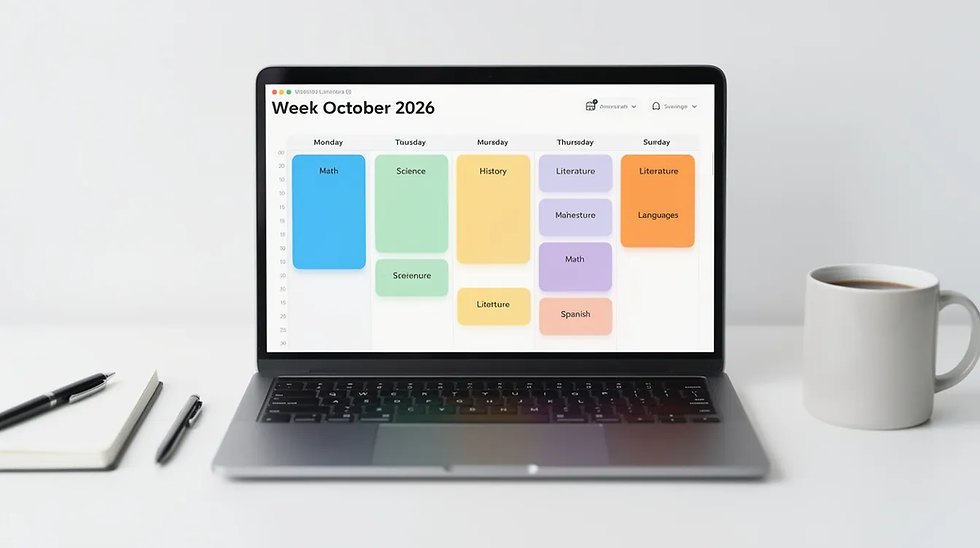
Step-by-step process:
List all your classes and their meeting times
Note exam dates, assignment deadlines, and any graduate school application deadlines
Reserve 30-90 minute study blocks on specific days for each course
Schedule breaks, meals, and sleep as non-negotiable
Color-coding tip: Use different colors for each course (blue for chemistry, green for history) in your calendar app or paper planner. This visual system helps you balance study time across subjects.
Sample schedule for a student taking four courses:
Day | Morning | Afternoon | Evening |
Monday | Classes | 45 min Psychology review | 45 min Calculus problems |
Tuesday | Classes | Study group (60 min) | Free time |
Wednesday | Classes | 45 min History reading | 30 min flashcard review |
Thursday | Classes | Practice exam (60 min) | Rest |
Friday | Classes | 30 min weekly review | Social time |
Saturday | 90 min intensive study | Free time | Free time |
Sunday | Plan upcoming week | Light review | Rest |
This approach spreads study hours across the week rather than piling everything into Sunday marathons. |
Use Time Blocking and Short, Intense Sessions
Time blocking is an effective technique where students allocate specific time slots for studying different subjects, helping to overcome procrastination and manage time efficiently. Instead of vaguely planning to “study economics,” you schedule “ECON 101 practice tests, 6:00-6:45 PM Tuesday.”
Short, intense sessions (25-50 minutes) with clear goals beat long, fuzzy study periods where attention drifts. The Pomodoro Technique involves working in focused blocks of typically 25 minutes followed by a 5-minute break to prevent burnout. However, if you’re in a flow state, don’t let an arbitrary timer pull you out—extend the block and take a break when you hit a natural stopping point.
Concrete patterns:
Two 45-minute blocks after dinner Monday through Thursday
10-15 minute breaks between blocks (walk, stretch, refill water)
One longer 90-minute session on weekends for practice tests
The goal is staying in flow and protecting study time from competing demands. Many successful students study around 3 hours daily (as researcher Andrew Huberman has noted), emphasizing challenging study that feels effortful rather than passive review.
Prioritize Tasks and Avoid Overload
Using the Eisenhower matrix can help prioritize tasks by categorizing them into four groups: urgent and important, important but not urgent, urgent but not important, and neither urgent nor important. Pairing this with essential time management strategies for students helps you focus first on tasks that are both urgent and important—like tomorrow’s quiz—before low-impact busywork.
Simple daily to do list structure:
Must do today: Quiz prep, read assigned chapter
Should do this week: Start essay outline, review flashcards
Nice if there’s time: Reorganize notes, explore extra readings
Watch for overload signs: taking too many courses, too many clubs, or working too many hours in a single term. If you’re consistently unable to complete your study plan, have an early conversation with an academic coach or advisor. Sometimes cutting one nonessential commitment protects your ability to succeed in what matters most.
Scenario: A student realizes their October 2026 chemistry midterm conflicts with a heavy work week. Rather than cramming, they request reduced hours at their coffee shop job for that week, protecting time for their practice exam and final review.
How to Eliminate Distractions and Stay Focused

Research shows that multitasking and constant notifications reduce learning efficiency and increase overall study time needed. Students who reported being distracted for a larger percentage of their study time tended to score lower on exams, indicating that distraction negatively impacts academic performance. Phone notifications alone can drop cognitive performance by 10-15 IQ points equivalent.
“Eliminate distractions” means designing both your environment and your habits so that focus is the default, not something you have to fight for.
This section covers:
Physical workspace design
Phone and social media management
Mental distraction handling (worries, random to-dos)
Design a Distraction-Free Study Environment
Your study space shapes your concentration. Minimize distractions by using website blockers and choosing a quiet study spot for effective studying.
What a good study space looks like:
Clear desk with only necessary materials
Comfortable chair and good lighting
Minimal visual clutter
Quiet location or noise-controlled environment
Location examples:
A quiet corner of the library
A specific table in a campus study hall
A designated desk at home (not your bed)
Consider using over-ear headphones with white noise or classical music without lyrics during demanding tasks. Some students focus better with instrumental music; others need silence. Experiment to find what works for you.
Set a visible start and end time for each session, treating it like a meeting with yourself. This structure makes it easier to protect your own pace and resist interruptions.
Reduce Multitasking and Digital Interruptions
Eliminating distractions, such as keeping your phone out of sight and asking family members to respect your study time, can significantly improve focus while studying. Even seeing your phone—without touching it—can reduce performance on complex tasks.
Concrete steps:
Put your phone in another room or inside a bag
Use “Do Not Disturb” or focus modes
Log out of social media on your study device
Using focus apps that block distracting applications and setting timers for study sessions can help minimize distractions and enhance concentration during study periods
Keep a small “not now” pad next to you. When random thoughts pop up (“I need to text Sarah,” “What’s for dinner?”), jot them down and return to studying. This prevents mental loops without losing the thought entirely.
Reward yourself with 5-10 minutes of phone time only after completing a defined study block or practice test. This maintains motivation without letting distractions hijack your session.
Create a Pre-Study Ritual to Stay Focused
A simple 3-5 minute ritual before each study block trains your brain to associate those steps with deep focus.
Example sequence:
6:55 PM: Clear desk, close unnecessary tabs
6:57 PM: Fill water bottle, gather materials
6:59 PM: Review today’s study goal (written on a sticky note)
7:00 PM: Start timer and begin practice questions
Repeating the same steps before every session creates a psychological cue that signals “it’s time to focus.” Over several weeks, this ritual becomes automatic, reducing the mental effort needed to get started.
Experiment with what works for your environment and daily schedule. Some students add a 30-second breathing exercise; others prefer reviewing their assignment list. The key is consistency.
Protecting Your Well Being While You Study
Good study habits support both grades and health. Cognitive performance depends heavily on physical well-being—chronic stress and sleep loss directly undermine effective study no matter how good your strategies are.
Three pillars to prioritize:
Sleep and recovery
Breaks and movement
Basic nutrition and hydration
Sleep: The Most Underrated Study Habit
Sleep is crucial for memory consolidation, with a recommendation of 7-9 hours per night. During sleep, your brain processes what you studied, transferring information from short-term to long-term memory. Skipping sleep to cram actually undermines this consolidation process.
Guidelines for good sleep during exam periods:
Maintain a consistent bedtime, even during finals week
Avoid starting new material after 10 PM the night before a big exam
Set a cut-off time for studying (e.g., stop by 11 PM for an 8 AM April 2026 final)
Simple nightly routine:
Shut off screens 30 minutes before bed
Review a few flashcards lightly (no intensive studying)
Sleep at the same time each night
Even during busy exam weeks, protecting core study hours often improves exam performance more than extra late-night cramming. Getting adequate sleep and staying hydrated can improve cognitive performance and mood, which are essential for effective studying.
Use Breaks and Movement to Maintain Energy
Taking intentional breaks while studying can strengthen retention, improve attention, and increase energy levels. According to a 2022 meta-analysis, resting for even ten minutes can improve focus and reduce fatigue. Research shared by the National Institute of Health indicates that people who take more frequent breaks learn with much greater ease.
Concrete break activities:
Take a break with a short walk (5-10 minutes)
Stretch at your desk
Fill a water bottle
Light snack (nuts, fruit)
Breathing exercises
Avoid scrolling social media during breaks—this often extends “5 minutes” into 30 and fragments your focus for the next block.
Suggested pattern:
45 minutes focused study
10 minutes movement and rest
Repeat
Regular exercise can enhance brain function by increasing oxygen flow to the brain, promoting the development of new nerve cells, and improving mental health, all of which support effective studying. Even brief movement helps maintain mood and reduces anxiety during intense study periods.
Basic Nutrition and Hydration for Studying
Eating a healthy diet, including fruits, vegetables, and plant-based proteins, has been linked to better cognitive performance and can help students stay energized and focused while studying. Your brain uses significant glucose during intensive thinking, and blood sugar crashes can derail concentration.
Realistic examples:
Keep a water bottle at your desk and sip during practice tests
Choose snacks like nuts, fruit, or yogurt over candy or chips during late-night sessions
Eat regular meals rather than skipping breakfast before a morning class
Don’t experiment with heavy or unfamiliar foods right before a major test. Stick to meals that keep you alert and comfortable. Caffeine can help alertness but avoid excessive amounts that cause jitters or disrupt sleep later.
Sample 7-Day Study Plan Before an Exam
Here’s a concrete example combining study strategies, time management, and focus habits for an exam one week away. This plan is based on a realistic scenario: preparing for a Tuesday, 20 October 2026 midterm in introductory psychology.
Day | Date | Activities | Time |
Day 1 | Mon, Oct 13 | Create flashcards for Chapters 1-3; write 3-sentence summaries for each chapter | 60 min |
Day 2 | Tue, Oct 14 | Complete Practice Test #1 (timed, no notes); review wrong answers | 75 min |
Day 3 | Wed, Oct 15 | Flashcard review (spaced); explain 3 concepts in own words aloud | 45 min |
Day 4 | Thu, Oct 16 | Study group session: teach one concept each, 10 practice questions together | 90 min |
Day 5 | Fri, Oct 17 | Practice Test #2 (new questions); create own questions for weak areas | 60 min |
Day 6 | Sat, Oct 18 | Light review of flashcards; focus on identified weak points | 45 min |
Day 7 | Sun, Oct 19 | Final review: skim summaries, do 10 quick self-test questions; early bedtime | 30 min |
Exam Day | Tue, Oct 20 | Good sleep the night before; light breakfast; arrive early | — |
Key principles in this plan: |
Distributing studying across the week (spaced repetition)
Active strategies every day (practice tests, self-explanation, flashcards)
Decreasing intensity as exam day approaches
Protecting sleep Sunday night
Adapt this structure to your own course and exam timeline. The pattern works for content-heavy courses, problem-based courses (substitute problem sets for flashcards), and writing-intensive courses (substitute outline practice for self-quizzing).
Frequently Asked Questions About Study Habits
How many hours per day should I study?
The “right” amount depends on your course load and difficulty, but many full-time college students benefit from 2-4 focused study hours on weekdays and slightly more before major exams. Quality trumps quantity: two 45-minute active sessions with practice tests and own-words summaries outperform four hours of distracted rereading.
Start with realistic blocks (e.g., two half hours to 45-minute sessions per day) and adjust based on your grades and stress levels. Remember that your schedule should also include breaks, sleep, and personal time to support long-term well being.
What if I work or have a busy family schedule?
Many learners in 2026 juggle jobs, caregiving, or commuting that make long daytime study blocks unrealistic. Break study time into smaller windows—20-40 minutes before work, during lunch at a coffee shop, or in the evening after kids are asleep.
Plan these windows in your weekly calendar and focus on the highest-impact tasks first: review key formulas, do 5-10 practice questions, or update flashcards. Communicate with family or housemates to protect a few non-negotiable quiet periods each week, especially before big exams. Even a professor will understand if you explain constraints early.
How can I stop procrastinating when I know what to do?
Procrastination often comes from tasks feeling too big or vague, not from laziness. Break work into very small, clear steps—“do 5 practice questions” instead of “study chemistry”—and commit to just one step.
Use a visible timer for an initial 10-15 minute “just start” block to overcome first resistance. Write down what you’ll do (“read pages 45-50, then write 3 questions”) rather than leaving it open-ended. Track small wins in a notebook; seeing progress builds momentum and develops self motivation. Following steps this simple can break the cycle.
Are digital tools like AI and apps helpful or distracting?
Digital tools help when they support active learning—like generating practice questions or explaining tough concepts—but harm learning when they replace thinking or encourage multitasking. Set clear rules: only use AI to clarify confusion after attempting a problem yourself.
Close extra browser tabs during study time and keep notifications off. Dedicated apps for flashcards or website blocking can support your plan, but tools should fit into an intentional study schedule, not dictate it. The learn process still requires your active engagement.
How do I adapt study habits if I have a different learning style?
While people have preferences, research supports using a blend of methods rather than relying on a single “learning style.” Mix formats—diagrams, spoken explanations, practice problems—while keeping core principles like spaced repetition and active recall.
Examples by preference:
Visual learners: draw concept maps and timelines
Verbal learners: explain topics aloud or write summaries
Hands-on learners: build physical models or create simulations
Experiment and honestly reflect on what improves your test results. Develop habits based on evidence of what works for you, not labels. Success requires adapting strategies to your life, testing them, and refining your approach each week.
Conclusion: Turning Study Tips into Lasting Habits
Building effective study habits comes down to a few core principles: use active strategies like practice tests and explaining concepts in your own words, create a structured study schedule that protects your focus, eliminate distractions by designing your environment intentionally, and care for your sleep and well being throughout the term.
Small, consistent changes made over the next 60-90 days—roughly one school term—can transform both your grades and your confidence. You don’t need to overhaul everything at once. Pick one or two changes to implement this week: perhaps creating a 7-day study plan before your next exam, or committing to put your phone in another room during study sessions.
Effective studying is a learnable skill, not an inborn talent. The habits you build now will compound through future courses, graduate school applications, career development, and lifelong learning. Start today with one practice test, one focused study block, one early night of good sleep. Your future self will thank you.


