

How to Mentally Prepare for an Interview

In 2026, landing a job interview is harder than ever. LinkedIn’s latest Workplace Learning Report shows a 35% increase in average applicants per role, pushing numbers past 200 candidates for many positions.
Add to this the shift toward hybrid hiring—62% of interviews now happen via video platforms like Zoom or Microsoft Teams—and the pressure intensifies. Seeing your own face on screen can amplify self-consciousness, with nearly half of candidates reporting heightened anxiety during virtual calls.
This is why learning how to mentally prepare for an interview has become as essential as polishing your resume or researching the company. This guide focuses on practical mental strategies: building the right mindset, planning effectively, mastering body language, and handling tough interview questions with confidence. These tips apply whether you have a job interview coming up in-person or through video, and work for both entry-level applicants and experienced professionals.
You’ll learn how reviewing the job description, using the STAR method, practicing positive affirmations, and preparing questions for the interviewer can transform your approach. The most important thing to remember: feeling nervous is normal. Most people experience anxiety before a big interview. With the right preparation, you can manage those nerves and present your best self.
Why Mental Preparation Matters Before a Job Interview
Mental readiness directly affects clarity, confidence, and first impressions during an interview. When stress hijacks your thinking, you might mix up project dates, forget a key achievement, or omit important metrics like “increased leads by 150%.” Thorough preparation is essential for building confidence and reducing anxiety prior to an interview—research shows unprepared candidates make 22% more articulation errors during high-stakes conversations.
Anxiety doesn’t just stay in your head. It leaks through body language: fidgeting, foot tapping, rushed answers, or avoiding eye contact. Interviewers notice these signals. A Princeton study found that first impressions solidify within 7 seconds, and nervous behaviors can undermine your message before you finish your first response.
In 2026, employers often interview many candidates in a single week—sometimes 50 or more per role. A SHRM survey revealed that 78% of hiring managers prioritize composure under pressure over technical skills in first-round decisions. Mental preparation helps you stand out by projecting calm focus when others appear scattered. Think of it this way: mental prep is as important as researching the company or tailoring your resume. Drawing on essential strategies for succeeding in high-pressure interviews can make this preparation more targeted and effective. It’s the invisible advantage that separates good fit candidates from great ones.
Recognizing Your Own Interview Stress Triggers
Not everyone experiences interview anxiety the same way. Common signs include sleeplessness the night before, racing thoughts on the commute, or feeling unusually irritable in the days leading up to your actual interview. Some people notice physical symptoms: tight chest, sweaty palms, or a racing heart. Others over-prepare every line until their responses sound robotic.
Here are specific symptoms to watch for:
Difficulty sleeping or waking frequently
Blanking on simple questions during practice
Over-rehearsing to the point of sounding scripted
Feeling distracted or unable to focus on other tasks
Physical tension in shoulders, jaw, or stomach
Admitting to feeling nervous can humanize you and make you feel more comfortable during the interview process. Here’s a useful reframe: anxiety and excitement feel nearly identical physically. Consciously reframing nervousness as excitement can channel that nervous energy positively.
Try a quick self-check exercise the day before: rate your physical tension, thought speed, and mood on a scale of 1-10. Identifying your personal triggers is the first step to choosing the right calming strategy.
Clarify the Role: Study the Job Description and Employer
Clarity about the role reduces anxiety and helps you mentally prepare with confidence. Vague understanding of what you’re interviewing for spikes dread significantly—one career study found uncertainty anxiety increases by 42% when candidates haven’t thoroughly reviewed the position.
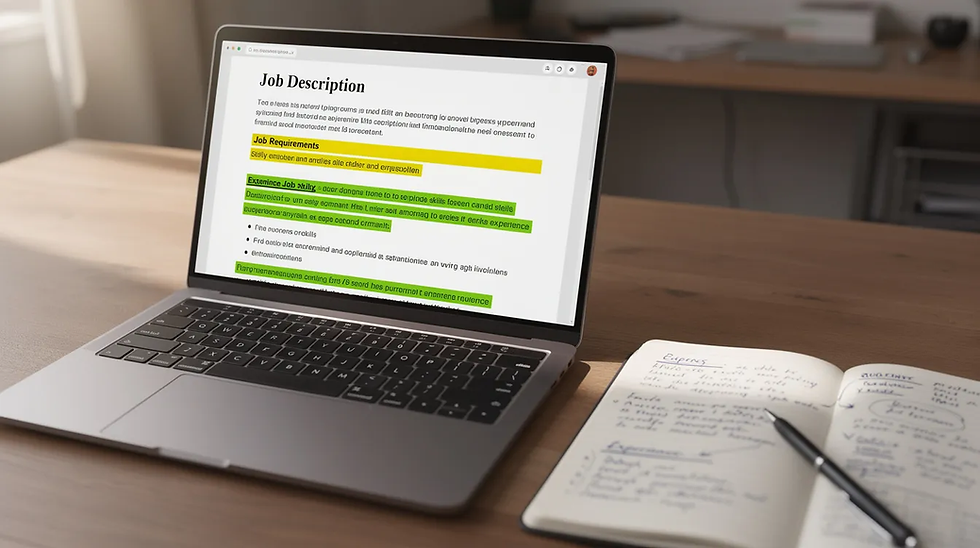
Here’s a specific process to follow:
Print or save the job description
Highlight 5-7 key skills and responsibilities
Rewrite each highlighted point in your own words
Match each requirement to one concrete example from your experience, dated if possible (e.g., “2024 marketing internship campaign that increased engagement 35%”)
Understanding the key selection criteria and position description is crucial for aligning your experiences with what the company is looking for in a candidate.
Next, research the company. Researching a company’s mission, values, and culture can help you understand what they prioritize and how you might fit into their environment.
Utilizing resources like the company’s website, social media, and news articles can provide insights into their recent activities and overall reputation. Look for recent news—a 2025 product launch or Q1 2026 earnings call—that you can reference naturally during your conversation.
Build a Confident Mindset Ahead of Interview Day
Shift your thinking from “I hope they like me” to “I’m assessing fit while presenting my strengths.” Effective mental preparation for a job interview involves shifting your mindset from being an applicant to being a collaborator in a professional conversation. Viewing the interview as a meeting of equals helps in ensuring it is a mutual fit for both you and the potential employer.
Create a one-page confidence sheet listing 5-10 achievements with dates and outcomes. Examples might include:
Q1 2025: Closed $500K in deals, exceeding quota by 140%
Summer 2024: Led volunteer team of 8, completing project 2 weeks early
2023: Resolved customer escalation, retaining $10K annual account

Review this sheet the night before and morning of your interview to reinforce your value.
Using positive affirmations can increase your confidence and reduce negative emotions before an interview, as repeating encouraging statements helps to foster a positive mindset. Write affirmations that feel believable and specific:
“I communicate my ideas clearly under pressure”
“I learn quickly when faced with new problems”
“I bring valuable experience to this conversation”
Read these aloud 2-3 times daily in the week before your interview. Being able to reflect on your strengths and weaknesses is something employers appreciate, as it demonstrates self-awareness and the ability to grow. Self-awareness involves understanding your strengths, weaknesses, skills, and achievements, which can help you effectively showcase your value during an interview.
Practice Smart: Answering Interview Questions with the STAR Method
Behavioral questions make up roughly 70% of interviews in 2026. These are questions like “Tell me about a time you disagreed with a colleague” or “Describe a situation where you had to meet a tight deadline.” Using the STAR method, which stands for Situation, Task, Action, and Result, can help candidates structure their responses to behavioral interview questions effectively.
Here’s how each component works:
Component | Description | Example |
Situation | Set the context | “In Q2 2025, our customer service team faced an escalated complaint” |
Task | Explain your responsibility | “I was assigned to resolve the issue and retain the client” |
Action | Describe what you did | “I analyzed support logs, called the customer directly, and offered a solution” |
Result | Share the outcome | “We retained a $10K annual account and received positive feedback” |
Candidates should prepare specific examples that relate to their strengths, as this can help illustrate their self-awareness and suitability for the role during an interview. Prepare 3-5 adaptable STAR stories covering themes like teamwork, problem-solving, leadership, and handling conflict.
Practicing responses to common interview questions can help candidates feel more confident and prepared, especially for questions like “Tell me about yourself” and “What are your strengths?” Mock interviews with friends or family can provide valuable practice and feedback, helping candidates refine their responses and improve their comfort level during actual interviews. Mentally rehearsing these stories reduces fear of blanking when tough interview questions appear.
Calming Techniques: Breathing, Visualization, and Body Language
Mental preparation also involves training your body’s stress response. Practicing deep breathing techniques helps activate the parasympathetic nervous system to calm anxiety. Your body can actually train your mind to feel confident. Try this breathing exercise before logging into a video interview or while sitting in the waiting room:
Box breathing technique: Inhale for four counts, hold for four, exhale for four, and pause for four. This method is clinically proven to lower heart rate and reduce stress. Performing deep breathing exercises can help center your mind and relax your body before an interview, reducing anxiety and allowing you to focus on being calm while speaking.

Visualization of success can positively influence performance during interviews. Positive visualization involves picturing a successful interview from start to finish including clear answers and building rapport. The night before, spend 5-10 minutes imagining yourself walking into the room (or joining the call), answering questions clearly, and leaving feeling proud. Focus on the process, not just “getting the job.”
Grounding techniques like the 5-4-3-2-1 exercise can help calm nerves before an interview. Notice 5 things you can see, 4 you can hear, 3 you can touch, 2 you can smell, and 1 you can taste.
Key body language tips:
Sit upright with shoulders back
Use measured, purposeful gestures
Maintain steady but natural eye contact (look at the camera for virtual interviews)
Research shows that 55% of communication impact comes from nonverbal signals, and confident posture can boost your sense of control.
Prepare Questions for the Interviewer to Stay Mentally Engaged
Preparing thoughtful questions shifts your mindset from passive candidate to active participant. Remember, an interview is a two way street—you’re evaluating them as much as they’re evaluating you. Having a list of thoughtful questions to ask the interviewer demonstrates interest and ensures a good fit.
Consider questions like these:
“How does the team collaborate on [specific skill from job description]?”
“What would success look like in the first 90 days?”
“What growth opportunities exist for someone in this position?”
“What’s a recent challenge the team has overcome?”
“How would you describe the company culture?”
Avoid asking about salary and benefits in early rounds unless the employer raises them first—65% of hiring managers consider this a red flag in initial conversations. Write your questions in a notebook or document. This reduces last-minute panic and helps you feel more in control. Questions aligned with the job description signal that you’ve carefully studied the role.
Plan the Practical Details to Reduce Last-Minute Stress
Logistics planning connects directly to mental calm on interview day. Uncertainty about basics like time, location, or technology creates unnecessary anxiety.
At least 48 hours in advance:
Confirm interview date, time, and time zone (especially for remote positions)
Verify the interview location or test video call links
Check your internet speed (aim for 50+ Mbps for video), camera angle, and microphone
Choose your interview attire and try it on—dress professionally but prioritize comfort
Plan your travel time with buffer for delays. For in-person interviews, arrive early by 10-15 minutes. For virtual ones, log in 5-10 minutes before the scheduled time.
Set alarms and create a simple schedule for interview day: wake time, review time, and departure or login time. This frees mental energy for performance rather than scrambling.
Interview Day: Pre-Interview Routine to Get in the Right Headspace
A consistent routine signals to your brain that it’s time to perform. Think of athletes who follow the same warm-up before every competition—your interview deserves similar preparation.
Sample 60-90 minute pre-interview routine:
Time | Activity |
60-90 min before | Light movement: a short walk or stretching |
45-60 min before | Healthy snack with protein for stable energy |
30-45 min before | Review confidence sheet and STAR stories |
15-30 min before | Deep breathing, posture check, 2-3 affirmations |
5-10 min before | Arrive or log in, settle into a quiet space |
Engaging in physical activity, like light exercise or a walk, can help release nervous energy and improve focus. Limit last-minute cramming—it often increases anxiety rather than reducing it.
Accept that some nerves are normal. Visualizing positive outcomes and experiences before an interview can help establish a positive mentality, boosting confidence and reducing nervousness during the actual meeting. Reframe that nervous energy as readiness and focus.
After the Interview: Reflect, Follow Up, and Protect Your Mindset
Your mental preparation continues after you leave the room or end the call. How you process the experience shapes your confidence for future interviews.
Within an hour of finishing, write down:
3 things that went well
2 areas to improve for next time
This reflection while memory is fresh turns every interview into a learning opportunity.
Sending a thank-you email within 24 hours after an interview shows appreciation for the interviewer’s time and reinforces your interest in the role. Mention one or two specific topics you discussed to make it memorable.
If you haven’t heard back from the employer after 5-7 days, a polite follow-up can be helpful to inquire about your application status and request feedback. Following up after an interview can keep you fresh in the employer’s mind and may lead to future opportunities if the first-choice candidate declines the offer.
While waiting, continue applications elsewhere. Don’t tie your self-worth to a single outcome. Each interview is practice that builds long-term confidence and skill, even if you don’t receive a job offer.
FAQs
How far in advance should I start mentally preparing for a job interview?
Light preparation can begin as soon as the interview is scheduled, even if it’s 7-10 days away. A practical timeline: spend the first couple of days researching and reviewing the job description, build your STAR stories mid-week, and focus on mindset and calm techniques in the final 48 hours. Even with only a day or two, focused preparation on key points still helps significantly. Prioritize the job description and 2-3 STAR examples if time is limited.
What should I do if I completely blank on an interview question?
Take a slow deep breath and ask the interviewer to repeat or clarify the question. Buy a few seconds by saying “That’s a great question—let me think for a moment.” If you can’t recall a perfect example, use a related STAR story focusing on similar skills like problem-solving or communication. If you truly cannot answer, be honest and express curiosity about how the company handles similar situations. Interviewers appreciate authenticity over a fumbled fake response.
How can I recover mentally after a bad interview experience?
Write down what went wrong and what went right within 24 hours, separating controllable factors from bad luck. Turn each mistake into a concrete action step—perhaps practicing a new STAR story or refining your body language for the real interview next time. Normalizing setbacks as part of the hiring process protects long-term confidence. Remember that 80% of job seekers report at least one difficult interview experience. Each one teaches you something for future interviews.
Does mental preparation differ for virtual versus in-person interviews?
Core mental strategies—positive affirmations, STAR stories, breathing exercises—stay the same for both formats. However, logistics preparation changes significantly for video interviews. Practice looking into the camera rather than at the screen, consider hiding your self-view to reduce self-consciousness, and minimize digital distractions. Doing a short test call with a friend before the real interview helps you relax with the technology and troubleshoot any issues.
How can I manage interview anxiety if I have very little professional experience?
Focus on experiences from school, volunteering, personal projects, or part-time work that demonstrate transferable skills. Interviewers expect entry-level candidates in 2026 to draw on a mix of academic and life experiences, not just full-time jobs. Preparing examples that highlight eagerness to learn, reliability, and quickly picking up new tasks will serve you well. Your ability to explain how you’ve grown through these experiences matters more than having years of employment history.
Conclusion
Mental preparation is the foundation of strong interview performance. By building the right mindset through positive self talk and affirmations, planning effectively with job description analysis and STAR stories, and practicing calm techniques like breathing and visualization, you give yourself a measurable advantage. Research shows mentally prepared candidates are 2.3 times more likely to advance in competitive hiring processes—and that edge compounds with each interview you complete.
Confidence isn’t something you either have or don’t. It’s built over time through repeated preparation, honest reflection, and learning from every conversation. Rather than trying to implement every strategy at once, choose 2-3 techniques from this guide to focus on before your next upcoming interview. Perhaps start with creating your confidence sheet, preparing 3 STAR stories, and practicing box breathing.


